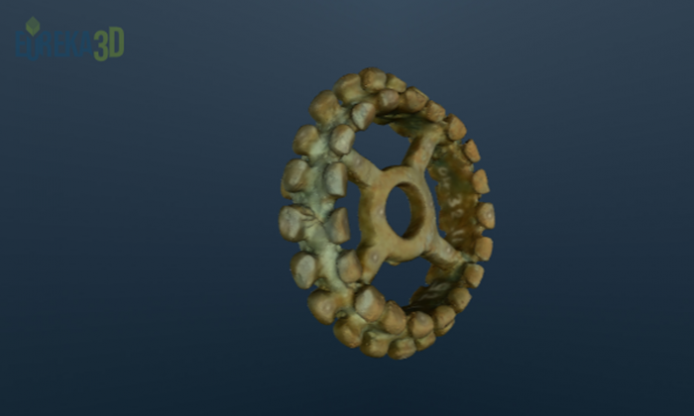
img. Rouelle. Digitised model by Musée Bibracte, in collaboration with EUreka3D project. EUreka3D project/Bibracte EPCC CC BY-SA
Bibracte provided to the EUreka3D project 500 scans of furniture, structures, and terrain from the archaeological site of Mont Beuvray (Burgundy, France). Originally, the digitisation plan also included a collection of coins, but during the selection phase of the objects to be digitised it was considered preferrable and more interesting to expand the collection of artefacts, that would better depict and illustrate the everyday life of the site inhabitants. These scans cover various periods, ranging from the Gallic oppidum (fortified settlement) seat of the Aedui tribe, active from the end of the 2nd to the late 1st century BC, to more recent occupations, such as the Cordeliers convent. The latter, established in the 14th century in the Pâture du Couvent district, was frequented by Franciscans until the end of the 17th century. The scientific partners of the establishment have been involved in all stages of the production, use, and dissemination of these scans, which are divided into three distinct collections aimed at supporting archaeological research and enriching the visitor experience on the site and in the museum.
3D Digitisation of Collection Objects: This collection includes 3D models of 130 artefacts representative of the material culture of the oppidum of Bibracte, a fortified city from the 1st century BC located on Mont Beuvray. These objects illustrate various aspects of Gallic life, ranging from agriculture to weaponry, including art, hygiene, building materials, and means of transport.
Documenting an archaeological site: Collection Terrain: The collection brings together 250 models that document the history of archaeological research on Mont Beuvray and the technological evolution of the practice of photogrammetry applied to archaeology. The methodological process for the production of an orthomosaic from several digital photographs is an outstanding research outcome of Bibracte, also published in open access1 in collaboration with the UMR 6249 Chrono-environment (Besançon, France) and as part of the doctoral thesis of Quentin Verriez (2023, University of Burgundy, UMR 6298 ArTeHis).
3D Reconstruction: Collection Morphométrie: This collection includes 120 theoretical 3D models of ceramic vessel shapes. These models allow for the visualisation and calculation of reference morphometric parameters, thus facilitating the identification of sherds found on the site by archaeologists. Designed specifically to serve as a morphometric comparison reference, the collection assists archaeologists in the typological identification of newly scanned 3D sherds. Thanks to this reference, newly scanned ceramic fragments can be systematically compared to existing models, facilitating their identification and classification.
The new objects digitised in the EUreka3D project and published in Europeana.eu comprise of items from the Celtic oppidum in the Late Iron Age, to the monastics of the Couvent des Cordeliers, established in the 14th century and frequented by Franciscans until the very end of the 17th century.
 EUreka3D project is co-financed by the Digital Europe Programme of the European Union.