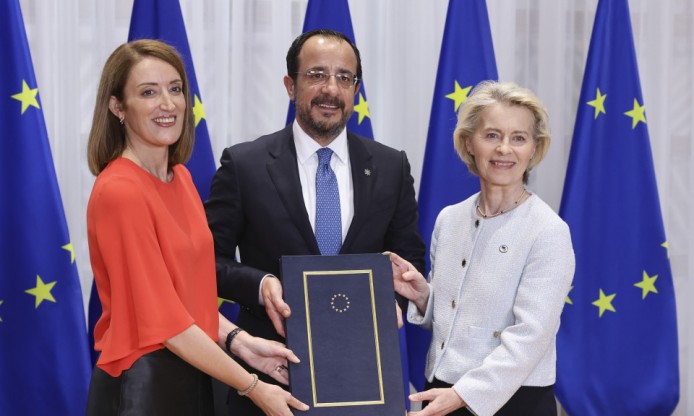
Signing ceremony for Joint Declaration “Europe for Culture – Culture for Europe”. img. courtesy: European Union.
For the first time in EU history, the three EU institutions signed a joint declaration reaffirming the EU’s role in protecting cultural and linguistic diversity and integrating cultural considerations across all EU policies, while respecting national competencies.
The institutions set out their commitment to placing culture at the heart of the European project by protecting and promoting artistic freedom, cultural diversity, inclusion and fair conditions for artists. Furthermore, they pledge to support the cultural and creative sectors by encouraging funding, innovation and capacity building, as well as by promoting Europe’s role as a global cultural and creative leader.
The Joint Declaration is the first deliverable of the Culture Compass for Europe, launched last year and acting as an anchor for culture within the next EU long-term budget for 2028-2034.
Twelve core principles
The commitments laid down in the declaration are organised around twelve overarching principles. Some of the principles focus on support for artists and cultural professionals and include pledges to protect artistic freedom of expression, promote fair pay and decent working conditions while respecting the role and autonomy of the social partners, and foster an ethical, human-centric and rights-based approach to the use of artificial intelligence.
Other principles in the joint declaration are aimed at fostering broader access to culture and to the cultural and creative professions, particularly for young, vulnerable or marginalised persons. They include commitments to enhancing inclusive access to culture, promoting arts education, and strengthening support for young artists and those from disadvantaged backgrounds.
The social and environmental benefits of culture are highlighted in the declaration. They are reflected in commitments to promote the positive effects of culture on health and wellbeing, harness the potential of culture to foster regional development, including through sustainable tourism, and stress the importance of culture in policy responses to ecological challenges.
The declaration also seeks to promote the EU’s cultural and linguistic diversity. Moreover, the three institutions commit to protecting Europe’s cultural heritage, including by using digital technologies to foster its preservation.
Text provided by the Council of the European Union’s website. Read the original post.